Engineering
Free Website Checks: What Each One Tells You, and What It Misses
A guide to the eleven free checks on this site — which question each one answers, what it cannot tell you, and which to run when something is wrong.
Most articles about free website tools are a list of links with a sentence of praise each. That is not very useful, because the hard part is not finding a tool. It is knowing which question you are actually asking.
Someone says "our site isn't ranking." That could be a speed problem, a crawler problem, a structured data problem, or nothing to do with the site at all. Someone says "our emails go to spam." That is almost never the email copy. Someone says "AI doesn't know we exist." That is two different problems wearing the same coat.
This is a guide to the eleven checks on this site: what each one answers, and — the part usually left out — what it will not tell you.
All of them run live. No sign-up, no email wall, and nothing invented: where a check cannot be performed, it says so rather than filling the gap with a number.
Start from the symptom
If you already know what is wrong, skip to the relevant section. If you only have a symptom, this is roughly where to start:
| What you are seeing | Start with |
|---|---|
| Pages are slow, or Google flags Core Web Vitals | SEO & Speed Audit |
| Links look wrong when shared on social | Meta Tag & Social Preview Checker |
| No rich results in Google despite having the markup | Structured Data Checker |
| Wrong language version ranking in the wrong country | hreflang Checker |
| AI assistants seem unaware of the site | AI & LLM Visibility Checker |
| AI knows the site but recommends competitors | AI Visibility Checker |
| Traffic dropped after a migration | Redirect Checker |
| A security audit or client questionnaire | Security Headers Scanner |
| Browser warnings, or an expiry you cannot confirm | SSL Certificate Checker |
| Email landing in spam | Email Deliverability Checker |
| A domain behaving oddly after a DNS change | DNS Records Lookup |
Search and visibility
SEO & Speed Audit
Answers: how fast the page really is for real users, and what on the page is working against it. The speed numbers come from Google's own PageSpeed API, so they are the same figures Google uses.
Will not tell you: why you rank where you do. Speed is one input among hundreds, and a perfect score has never by itself moved a page up. If your content does not match what the searcher wanted, no amount of optimisation here will fix that. Treat a poor score as a real problem worth fixing and a good score as one fewer excuse — not as a ranking forecast.
Background: why Core Web Vitals affect revenue before they affect rankings.
Meta Tag & Social Preview Checker
Answers: exactly what Google and every social platform will render for a URL — title, description, image, and where each is truncated.
Will not tell you: whether the title is any good. It measures fit, not persuasion. A title that fits perfectly and describes nothing anyone searches for is still a bad title.
Background: meta tags and social previews.
Structured Data Checker
Answers: every JSON-LD block on the page, whether it is valid, and which rich-result types it qualifies for.
Will not tell you: whether Google will actually show a rich result. Eligibility is necessary and not sufficient — Google decides per query, and has withdrawn whole rich result types before. Valid markup that produces nothing visible is normal, not a bug.
Background: the structured data guide.
hreflang Checker
Answers: whether your language alternates are declared correctly — and, unusually, whether each one points back. A one-way hreflang declaration is ignored, and that is the most common way multilingual sites quietly fail.
Will not tell you: whether the translations are any good. It checks the wiring, not the writing. A perfectly wired network of badly translated pages is a worse position than a single good one.
Background: international SEO and hreflang.
AI & LLM Visibility Checker
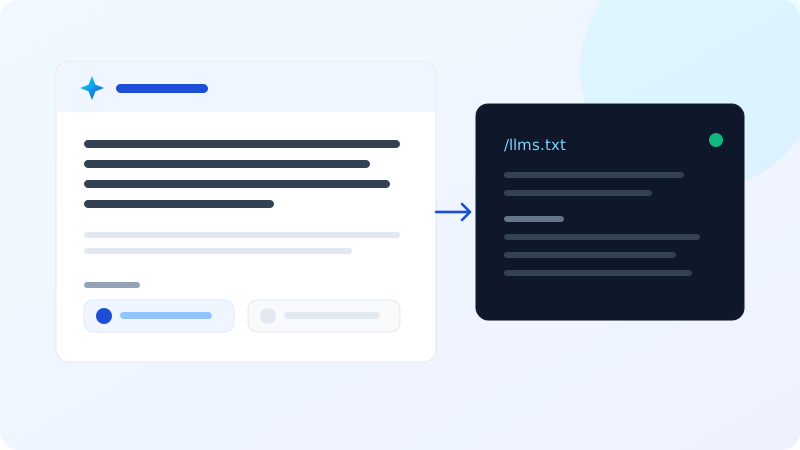
Answers: whether AI systems are allowed and able to read your site — crawler permissions, llms.txt, structured facts, how much content exists before JavaScript runs.
Will not tell you: whether they recommend you. Being readable is the prerequisite, not the outcome. This is the supply side.
Background: the llms.txt implementation guide.
AI Visibility Checker
Answers: the demand side. It asks ChatGPT, Gemini, Claude, Perplexity and Grok the question a customer in your city would ask, and reports whether you were named, where you came, and who was named instead.
Will not tell you: a stable ranking, because there is not one. Models answer differently each time. One run is a sample; the trend over months is the signal. The result prints how many engines actually answered, so a score from two is never mistaken for a score from five.
Background: how to find out whether AI recommends your business.
Delivery and infrastructure
Redirect Checker
Answers: every hop a URL takes, with the status code and time cost of each. Chains, loops, and the 302s that should have been 301s.
Will not tell you: whether the destination is the right page. A redirect that resolves cleanly to an irrelevant page is technically perfect and still a lost visitor — Google calls this a soft 404 and treats it accordingly.
Background: 301 vs 302 and when each is correct.
Security Headers Scanner
Answers: which HTTP security headers you send and which protections are missing.
Will not tell you: whether you are secure. Headers are one layer. A site with a perfect header score and an unpatched CMS is not a secure site — it is an insecure site with good headers. This check is most useful for the client security questionnaires that increasingly gate enterprise deals.
Background: HTTP security headers, in order of what matters.
SSL Certificate Checker
Answers: the live certificate — expiry, issuer, which hostnames it covers, TLS version.
Will not tell you: that renewal is automated. The most expensive certificate failure is the one nobody was watching, and a check you run manually is a check that will not be run on the day it matters. Use it to confirm coverage; use monitoring to confirm renewal.
Background: the SSL certificate guide.
Email and DNS
Email Deliverability Checker
Answers: live SPF, DKIM, DMARC and MX records, with the actual record text rather than a verdict.
Will not tell you: whether your mail arrives. Authentication is the floor. Once SPF and DMARC are correct, delivery depends on sending reputation, list quality, and content — none of which is visible in DNS. Correct records mean you have stopped being rejected for the obvious reason.
Background: the email authentication guide.
DNS Records Lookup
Answers: every DNS record for a domain, queried live from your own browser rather than a cache.
Will not tell you: what the records should be. It shows what is there. Deciding whether a TTL is too high or an MX priority is wrong is a judgement, not a lookup.
Background: DNS records explained.
What free checks cannot do at all
Worth saying plainly, because it is the boundary of this whole category.
They cannot tell you whether your content is good. Every check here is structural. None of them reads your writing and judges whether it answers what a buyer wanted to know. That remains the largest single factor and the least automatable.
They cannot see your competitors. A perfect technical result in a market where three competitors are also technically perfect tells you nothing about why you are losing.
They cannot tell you what to do first. Eleven green checks and eleven red ones both leave you with the same question. Sequencing is judgement — fix what is costing you money, not what scores worst.
They are a snapshot. Certificates expire, DNS changes, models update, competitors move. A check run once is a check that was true once.
A sensible order
If you are starting from nothing, this is the order that finds the most for the least effort:
- Redirects and SSL first. Both can take a site fully or partly offline, and both are quick.
- Then speed and structured data. These are the slow-burn ones where fixes compound.
- Then email. It fails silently and nobody notices until a customer says they never got the quote.
- Then AI visibility, both kinds. Readability first, then whether you are recommended. There is no point measuring the second while the first is broken.
- Then hreflang, if you run more than one language. It is either fine or badly broken, rarely in between.
Run the set quarterly, and after every migration, DNS change or certificate renewal. Most of what breaks a website breaks at one of those three moments.
Every tool listed here is on the tools page, runs live, and is free. If a result raises a question that a checker cannot answer, tell us what you are seeing — we will tell you whether it is worth paying anyone to fix.